
Generic sales emails don’t work for professional services. When you’re selling expertise (consulting, legal work, strategy, creative services), you can’t copy-paste your way to new clients. Your prospects aren’t looking for another vendor. They’re looking for someone who gets their specific problem.
This article shows you why most sales email templates fail for service providers and how to build emails that actually start conversations and close deals. Email templates are just one component of a comprehensive sales enablement strategy—for a complete overview of all the assets your team needs, see our guide to sales enablement assets for professional services.
Why Generic Email Templates Fail Professional Services
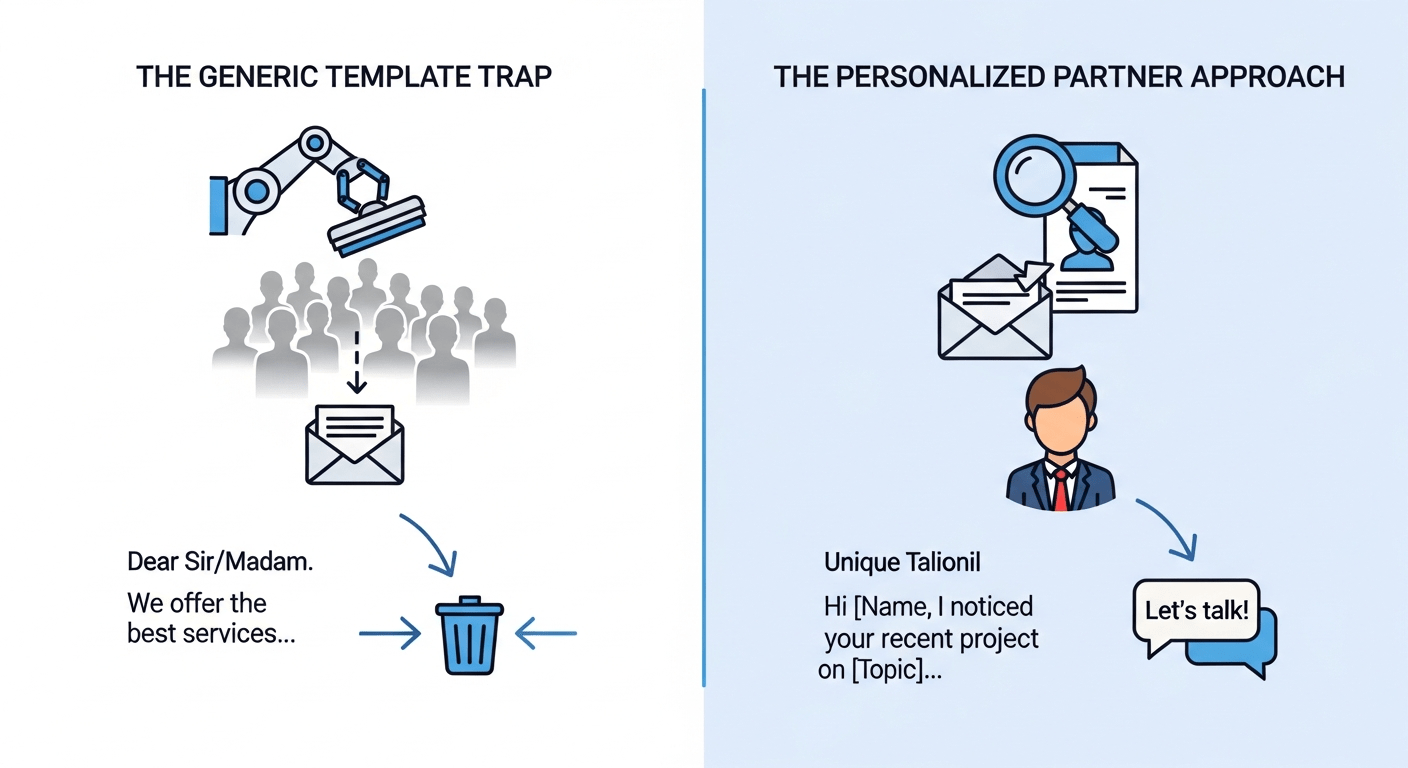
Your prospect’s inbox is a war zone. They’re getting hit with dozens of sales emails every day, and most sound exactly the same.
Here’s why copywriters and agencies struggle when creating emails for professional services: you can’t sell expertise the way you sell products. There’s no free trial. No feature demo. No tangible thing to show. You’re asking prospects to trust you with complex problems, significant budgets, and their reputation.
That requires a different approach.
When you copy-paste a generic email template, prospects can tell. Even when you swap in their company name and industry. The email feels templated. It doesn’t speak to their specific situation. It fails to show you understand their world.
Worse, it damages your brand. The prospect’s takeaway? This firm doesn’t get us. They’re not interested in our specific needs. They’re just another vendor blasting emails.
In professional services, where trust is everything and sales cycles are long, that first impression is expensive. You don’t just lose that opportunity. You lose credibility before you’ve even had a conversation.
The Foundation for Conversion: Understanding Your Prospect
Every effective sales email starts with understanding your prospect. Not just their industry or company size, but their actual challenges, goals, and what keeps them up at night.
Generic templates skip this step. That’s why they fail.
Understanding Prospects Beyond the Basics
You need more than basic data. Industry, company size, job title. That’s table stakes.
Dig deeper. What are their biggest pain points right now? What business objectives are they trying to hit this quarter? What internal challenges do they face? What does success look like for them?
Your service exists to solve a problem. Your email needs to demonstrate that you understand the problem and can fix it.
Skip the generic claims. “We improve efficiency” means nothing.
Get specific: “Missed project deadlines are costing you roughly $10,000 per incident.” Or: “Outdated IT systems are creating compliance risks that could result in legal liabilities.”
When you name the real pain point and connect it to a tangible outcome, you get their attention. That’s what makes emails resonate.
Real Personalization Goes Beyond First Names
Personalization isn’t just using their first name. That was table stakes in 2015.
Real personalization means doing your homework. What’s happening in their industry? Did the company recently announce a new initiative? Has their leadership made public statements about their priorities?
When you reference these specifics in your email, you prove you’ve invested time in understanding them. That changes the conversation.
Crafting Your Message: The “Stand Out” Framework for Professional Services Emails
Once you understand your prospect, you can build an email that captures attention and moves them toward action.
Here’s how to do it.
Strategic Subject Lines: Curiosity + Value
Your subject line determines whether your email gets opened. Period.
For professional services, your subject line should hint at a solution to a specific pain point, offer a valuable insight, or reference a shared connection.
Skip the generic sales pitches. They don’t work.
With 77% of B2B buyers preferring email communication and 43% of salespeople naming it their most effective channel, your subject line is your first, and sometimes only, shot at engagement.
Compelling Openers: Authenticity Wins
Your first sentence is your second chance.
Reference your research. Acknowledge a shared connection. Pose a relevant question about their industry or role.
Don’t use canned introductions. They signal you’re mass-emailing everyone.
A strong opener proves this email was written specifically for them. That builds the trust you need to sell professional services.
Value Propositions: Solve Problems, Not Sell Solutions
You’re not selling a product. You’re selling expertise and outcomes.
Frame your offering around the problems you solve and the results you deliver.
Instead of: “Our consulting product offers advanced analytics.”
Try: “We help businesses like yours use data insights to cut operational costs by 15%, improving profitability and freeing up budget for growth.”
See the difference? One talks about features. The other talks about what the prospect actually cares about: results.
Build Credibility with Social Proof
Trust is everything in professional services. Build it into your email.
Mention a relevant client success story (anonymized if needed). Share a piece of a compelling testimonial. Highlight your team’s specific expertise that matches their challenge.
The goal: show you’ve solved this problem before for companies like theirs.
Clear Calls-to-Action: One Next Step
Every email needs one clear next step.
Schedule a 15-minute call. Request a demo. Download a specific resource.
Make it low-friction and explain why it’s worth their time.
Don’t be vague. “Let me know if you’re interested” isn’t a CTA. “Would you be open to a 15-minute call next week to discuss how this applies to [their specific situation]?” is.
Professional Closing Lines and Email Signatures
Keep your closing simple and professional. “Sincerely” or “Best regards” works.
Your signature should include contact info, links to your website and LinkedIn, and maybe a relevant case study or company overview.
Keep it clean and mobile-friendly.
Email Frameworks for Professional Services (Not Copy-Paste Templates)
These frameworks give you structure while leaving room for the personalization that actually drives responses.
The Consultative Cold Outreach Email Framework
This approach prioritizes research, demonstrated value, and genuine consultation. You’re starting a conversation, not pushing a product.
Subject Line: Problem-focused or insight-driven.
- “Addressing [Specific Challenge] in [Company Name]”
- “An Insight on [Industry Trend] for [Company Name]”
- Reference to recent company news
Opener: Show you’ve done your homework.
- “I noticed your recent expansion into [new market] and the common challenges companies face scaling their IT infrastructure during rapid growth.”
Value Proposition: Connect their challenge to your solution.
- “We specialize in optimizing cloud infrastructure for fast-growing tech companies, helping them achieve seamless scalability and reduce overhead by 20% without performance issues.”
Credibility & Social Proof: Brief success mention.
- “We recently helped [Similar Company] navigate a similar scaling challenge, cutting their infrastructure costs 25% within six months.”
Call to Action: Low-friction next step.
- “Would you be open to a brief 15-minute call next week to discuss how this applies to [Company Name]’s specific situation? Here’s my calendar: [Link].”
This framework focuses on consultative selling, which works far better than generic outreach.
The Value-Driven Follow-Up Sequence Framework
Follow-up is critical in professional services. These emails should provide value, not just repeat your pitch.
Purpose: Nurture interest, address objections, provide insights.
Email 1 (Post-Initial Contact): Recap value and share a resource.
- “Following up on our conversation yesterday. I wanted to share this article on [relevant topic] that goes deeper into the cost-saving aspects we discussed.”
Email 2 (Value Add): Share relevant content or industry insight.
- “I came across this report on [industry trend] and thought of your work in [specific area]. It highlights opportunities for [specific benefit]. Attached is a summary.”
Email 3 (Gentle Nudge): Soft check-in with specific offer.
- “Just checking in. Have you had a chance to think about how [your service] might address the [specific pain point] we discussed? If you’re interested, I can send an overview of potential solutions.”
Email 4 (Re-engagement): For cold leads.
- “I know you’re busy. Wanted to share a quick insight about [new development in their industry]. Maybe this is more pressing now than a few months ago. When it becomes a priority, I’m here to help.”
Each email provides value, not just a reminder you exist.
Trigger-Based Emails: Timely and Highly Relevant Engagement
Use behavioral triggers to send contextual emails based on where prospects are in their decision process.
Trigger Event Examples:
- Prospect downloads a whitepaper related to their pain point
- Website visitor repeatedly views your service or pricing page
- Prospect clicks a link showing deeper interest
- Contact engages with your content on social platforms
Example (Whitepaper Download):
- “Thanks for downloading our guide on [Topic]. Given your interest, you might find our webinar recording on [Related Topic] useful for understanding [specific benefit]. Access it here: [Link].”
Example (Key Page Visit):
- “I noticed you explored our [Service Name] page. Many clients find this particularly effective for addressing [specific pain point]. Interested in a quick overview of how it works and typical results?”
These triggered emails are hyper-personalized and show awareness of active engagement.
Proposal and Meeting Request Email Frameworks that Convert
When moving prospects forward, focus on clarity, value, and mutual benefit.
Meeting Request Email:
Subject: Action-oriented and benefit-focused.
- “Meeting Request: Discussing [Prospect’s Goal] with [Your Company]”
- “Exploring [Specific Benefit] for [Company Name]”
Body: Briefly reiterate understanding and meeting purpose.
- “Based on our discussions, I’d like to propose a focused meeting to walk through how our expertise in [service area] can help you achieve [their desired outcome]. I’ve allocated 30 minutes on [Date] at [Time], but let me know if another time works better. Attached is a brief overview of our approach.”
Call to Action: Clear invitation to accept or suggest an alternative.
Proposal Review Email:
Subject: Direct and informative.
- “Proposal for [Project Name] from [Your Company]”
- “Following Up: [Your Company] Proposal for [Company Name]”
Body: Frame proposal as a collaborative step.
- “I trust you’ve had time to review the proposal for [Project Name]. We’ve outlined how our [specific services] address your objectives for [key goal]. I’d welcome the chance to walk you through it, answer questions, and discuss next steps. Available for a brief call next week? Here’s my scheduler: [Link].”
Attachment: Ensure proposal is clearly attached.
These frameworks keep critical sales process steps professional and focused on moving relationships forward.
Tools and Tactics for Consistent Conversion
Effective email outreach isn’t just what you say. It’s how you manage the process.
AI for Personalization and Efficiency
AI tools can help with prospect research, suggesting talking points, drafting initial emails, and optimizing subject lines.
The key: use AI to augment your work, not replace your human touch. AI helps you analyze data and personalize at scale while keeping messages authentic.
Automation with a Human Touch
Automation platforms handle repetitive tasks like sending follow-ups and managing contact lists.
But in professional services, maintain the human touch. Use automation for sequence management and reminders. Keep higher-value, personalized communication human-led.
That balance lets you scale without becoming impersonal.
A/B Testing and Performance Measurement
Optimize your emails by measuring performance and iterating.
A/B test subject lines, CTAs, and value propositions to see what resonates with your audience.
Track open rates, click-through rates, response rates, and conversions to meetings or closed deals. The professional services sector averages about 12% conversion, but you can beat that with optimized strategies.
Integration with Your Sales Workflow
Your email outreach shouldn’t exist in a silo.
Integrate email tools with your CRM and other sales platforms. This gives you a cohesive view of all prospect interactions, smoother handoffs between sales and marketing, and robust data tracking.
A well-integrated workflow ensures every touchpoint contributes to a unified customer journey.
Staying Professional and Authentic
Building lasting relationships in professional services requires consistent professionalism and authenticity.
Your Authentic Voice and Brand Tone
Your sales emails should reflect your brand’s personality and values.
Are you analytical, creative, or empathetic? Make sure your tone, from subject line to closing, aligns with that identity.
Authenticity builds trust, which is everything in services. Skip the jargon. Use clear, professional, human language.
That authentic voice resonates more than any template.
Email Deliverability Best Practices
The best email fails if it never reaches the inbox.
Follow email deliverability best practices: maintain clean lists, use double opt-in where appropriate, avoid spammy language, and protect your sending reputation.
Monitor your sender score and follow protocols to bypass spam filters and ensure your content reaches prospects.
Frequently Asked Questions About Sales Email Templates
What makes email templates effective for professional services?
Effective email templates for professional services balance structure with flexibility. Unlike product-based sales emails that can rely on features and demos, service-based templates need to demonstrate expertise, build trust, and address complex business challenges.
The most effective templates include:
- Research-driven personalization hooks that prove you understand the prospect’s specific situation
- Problem-focused frameworks that speak to actual pain points rather than generic benefits
- Credibility indicators like relevant case studies or client outcomes
- Low-friction CTAs that make the next step obvious and easy
- Enough flexibility to customize for individual prospects without starting from scratch
The key difference: product templates sell features. Service templates sell understanding and outcomes. When your template demonstrates that you “get it”—that you understand their world and have solved similar problems before—response rates increase dramatically.
How many follow-up emails should I send?
For professional services, the optimal follow-up sequence is 4-6 emails spread over 3-4 weeks, with each email providing distinct value.
Here’s the recommended cadence:
Email 1 (Day 3-4 after initial contact): Recap your value proposition and share one relevant resource or insight.
Email 2 (Day 7-10): Provide additional value—a case study, industry report, or article that addresses their specific challenge.
Email 3 (Day 14-16): This is where you make a direct ask, but frame it as an easy, no-brainer next step. Instead of just asking for a call, sell the benefits of that call. Example: “Would you be open to a brief 15-minute conversation next week? I can show you specifically how we helped [Similar Company] reduce [their pain point] by [specific outcome], and we can discuss whether a similar approach makes sense for [Prospect’s Company].” The key is making the time investment feel valuable and low-risk.
Email 4 (Day 21-24): Soft “breakup” email acknowledging they’re busy, but leaving the door open. Something like: “I know timing might not be right. When [specific challenge] becomes a priority, I’m here to help.”
Optional Email 5-6: If they’ve engaged at all (opened emails, clicked links), send periodic value-add emails (once every 4-6 weeks) with industry insights or relevant content.
The critical rules:
Every follow-up must provide value, not just remind them you exist. If you’re just saying “checking in” or “circling back,” you’re wasting their time and damaging your brand.
Every CTA should be easy to say yes to. Don’t ask for a 60-minute strategy session. Ask for 15 minutes to share one specific insight. Don’t ask them to “explore how we can help.” Tell them exactly what they’ll get from the conversation and why it’s worth their time.
Should I use the same template for all prospects?
Absolutely not. While templates provide structure and save time, using identical copy for every prospect is exactly what makes emails feel generic and get ignored.
The right approach:
Create template frameworks organized by:
- Buyer persona (CFO vs. COO vs. IT Director)
- Industry or vertical (healthcare, finance, manufacturing)
- Stage in buyer’s journey (cold outreach vs. warm lead vs. post-demo)
- Specific pain point (growth challenges vs. efficiency issues vs. compliance concerns)
Each framework should include:
- 2-3 subject line options specific to that scenario
- A personalization hook structure (what to research and reference)
- Core value proposition specific to that persona’s priorities
- Relevant social proof for that industry or use case
- Appropriate CTA for that stage
Then customize each email by:
- Inserting specific research about the company
- Referencing their industry challenges or recent news
- Adjusting tone based on previous interactions
- Tailoring case studies to their specific situation
Think of templates as your foundation, not your final product. The framework ensures consistency and saves time. The personalization is what makes it work.
How do I personalize at scale?
Personalization at scale is the biggest challenge in B2B sales email, but it’s achievable with the right approach and tools.
The 3-Layer Personalization Strategy:
Layer 1: Automated Personalization (Baseline)
- Merge fields for name, company, job title, industry
- Dynamic content blocks that change based on persona or industry
- Trigger-based emails sent based on specific actions (download, page visit, etc.)
This layer is table stakes. It’s necessary but not sufficient.
Layer 2: Semi-Automated Research (Efficiency + Impact)
- Use AI tools to pull recent company news, LinkedIn activity, or industry trends
- Create “research prompts” that help you quickly find personalization hooks
- Maintain a database of industry-specific pain points and talking points
- Set up Google Alerts or industry monitoring for key accounts
This layer is where most impact happens. You’re using technology to surface insights, but applying them thoughtfully.
Layer 3: High-Touch Personalization (Top Prospects)
- Deep manual research for highest-value prospects
- Personalized video messages or custom one-pagers
- References to specific initiatives, quotes from leadership, or recent achievements
- Completely custom emails that reference previous conversations or shared connections
Reserve this layer for your most strategic accounts where the deal size justifies the investment.
Tools that help:
- CRM integration: Track all interactions and surface relevant context automatically
- AI research tools: Tools like Grok, ChatGPT, or dedicated sales intelligence platforms can quickly summarize company news, leadership priorities, or industry challenges
- Email sequencing platforms: Tools like Outreach, SalesLoft, or HubSpot enable automated sequences with dynamic personalization
- LinkedIn Sales Navigator: Research tool for finding specific insights about prospects and their companies
The realistic approach:
For most professional services firms, a practical personalization strategy looks like:
- Layer 1 automation for all outreach (100% of emails)
- Layer 2 semi-automated research for qualified leads (top 30-40% of prospects)
- Layer 3 high-touch for strategic accounts (top 10-15% of prospects)
This approach lets you send meaningful, relevant emails at scale without burning out your team or sacrificing quality.
The key insight: personalization isn’t about writing every email from scratch. It’s about using frameworks and tools to efficiently deliver relevant, timely messages that prove you understand each prospect’s world.
Conclusion: Templates Are Powerful, But Building Good Ones Takes Real Work
Here’s the truth about sales email templates: when they’re done right, they’re game-changers for your team.
Good templates save your salespeople hours every week. They give your team a consistent voice. They codify what actually works so new hires can ramp up faster. And most importantly, they increase response rates and help you book more meetings.
But here’s what most people don’t realize: building effective templates takes significant work.
You need to understand buyer psychology. You need to know what pain points resonate in your specific market. You need to test different frameworks, CTAs, and value propositions. You need to write in a way that sounds consultative, not salesy. And you need to build in enough flexibility that templates can be personalized without starting from scratch.
That’s not something you knock out in an afternoon.
The vast majority of B2B sales interactions now happen digitally. Your email templates are competing with dozens of other firms for the same prospect’s attention. Generic templates don’t cut it. You need templates built specifically for professional services, written by someone who understands the unique challenges of selling expertise.
If you want email templates that actually convert, templates that position your firm as trusted advisors rather than another vendor, templates that your sales team will actually use because they work, let’s talk.
I specialize in creating sales enablement content for professional services firms—email templates, battle cards, one-sheets, call scripts, and more. I know how to translate complex expertise into clear value propositions.
Get in touch. Let’s build a template system that helps your team close more deals.