Archive for accountant marketing

Sage software recently released the findings from their survey of 500 members of their Accountants Network in the US. The survey, conducted last December, covered a number of topics including top concerns, specialization, and the members use of social media.

34% of those surveyed listed their top concern as getting new clients. Tax law complexity, new regulations, keeping up with technology, and time management were the other top concerns, according to the survey.

The survey found that, when it comes to using social media for business purposes, the most popular social media tools are the accountants own firm’s Web site (37%), followed by LinkedIn (28%), Facebook(19%), Twitter(7%), and YouTube(3%). Of those surveyed, 43% stated that they do not use social media at all for business.

You can find more information about the survey here.

How to talk about what you do

Thursday, July 29th, 2010

I think everyone, newly promoted or not, struggles with this one at some point in their career. How do we talk about what we do and talk about it without boring ourselves and everyone around us to tears.

The default, of course, is to fall back on your title – I’m a banker, I’m an accountant, I’m a attorney, etc. One of the main problems with this approach is that we, as human beings, like to categorize things. It helps us make judgments. So if you tell me you’re a banker, I put you in my mental banker box with all of the other bankers. I have family members who are bankers, I know what they do, so of course I know what you do. This isn’t accurate of course, but it happens.

Being put in a “box” can have a very negative effect, based upon the listener’s experience. I have had financial advisors tell me that they have had people walk away from them at networking events, as soon as they heard who they work for – ouch!

The Commercial

Soon we are told we need a 30 second introduction, a talking logo, an elevator pitch, or (my favorite) a a One-Breath commercial. Whatever you call it, this usually takes the form of a mini-speech, where you provide more detail about what makes you “unique”.

While all of these tools, when used correctly, are useful, I think you will be better off when you can have a conversation (vs. a speech) about what you do.

Your ability to have a conversation will vary with each setting. Even in cases where you can’t have a conversation (when you are going around the room introducing yourselves), you can give your “speech” in a conversational tone.

The Basics

You need to give people enough information to give people context. But that’s enough for now, just context. Your name, your company name, and your general field. You may need to leave out your company or field at this time if it would be detrimental  (see financial advisor example above).

Once you have provide some context, be specific about who you help and the problems you solve. The more specific you can be, the better. Your listener want to know 1) am I that person and 2) do I know anyone like that?

Also, the more specific you are, the more likely they are to remember you two weeks from now when they do run into someone with a problem that your solve.

A lot has been written about 30 second commercials. Rather than re-hashing that info here, I’d like to spend some time discussing how to be more conversational with your commercial.

Questions, questions, questions

When having a one on one conversation, ask the other person to tell themselves about you first. Ask questions to get a clear picture of what they really do (remember, most people are not good at explaining this) and figure out how you can help them.

Another way to be more conversational is to start off your “commercial” with a question. Use a question to see if the person you are talking to identifies with the problems you solve:

“Do you know how there seems to be a lot of questions about health care reform, but not a lot of answers? I work with small business owners to show how the new rules impact them and what they can do about it.”

Another way to use a question to create a conversation is to follow up with “you don’t happen to know anyone who would be interested in that, would you?” More often than not, the person you ask will need to ask you some clarifying questions before they can answer you. This can be a great way to gauge how well your message is coming across.

Even if

Using “even if” can help emphasize a point or help people get over an early objection. I’m sure you’ve heard this one before:

“We can put you in a car, even if they have less than perfect credit.”

Use “even if” to help start a conversation by dispelling common misconceptions about your service or industry.  For example, do most small businesses think they are to small to need your payroll services?

“We work with small businesses to take care of all of their payroll needs, even if they only have 1 employee.”

Maybe you provide sales training to accountants who think sales is just about making cold calls:

“I help accountants close more deals, even if they hate making cold calls.”

Paint a Picture

Using examples can be a great way to create a picture for those listening. Share (in general terms) a recent story about someone you worked with and how you helped them. Let’s pretend I’m an estate planning attorney

“  – for example, I worked with a couple last week who had a will and thought they had everything taken care of. However, if one of them died next week, they would have had a huge, unexpected burden because …”

Some people advocate having several different versions of your “30 second commercial”. I’m not a fan of that approach. If you feel you need to “vary your pitch” I would recommend doing so by using different examples of who and how you help.

I hope you find one or two things in this post that help you feel more comfortable talking about what you do.

Lead Scoring for Professional Service Firms

Wednesday, May 19th, 2010

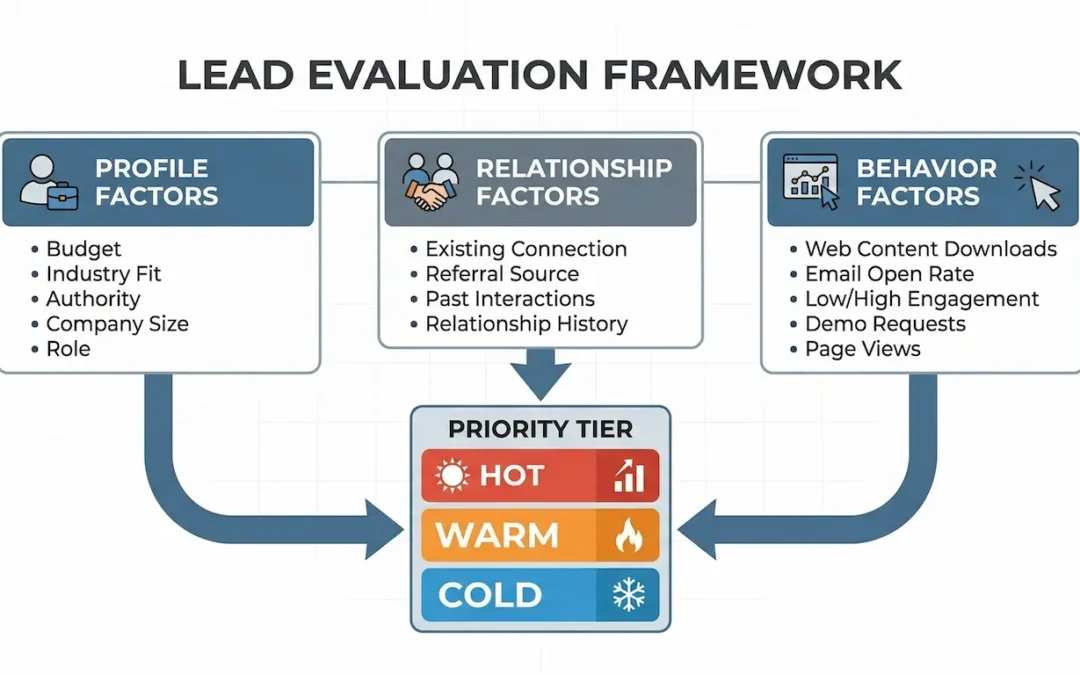
Another topic I’ve been hearing a lot about lately is lead scoring. Several people have asked me what lead scoring is and whether or not it makes sense for accounting, law, or other professional service firms. Here are some of my thoughts on lead scoring.

What is Lead Scoring?

Generally speaking, lead scoring is a method of assigning point values to your leads. The goal is to determine which leads are most ready to make a purchase so you can concentrate your sales efforts on them.

Points can be assigned by using information the prospect provides (their profile) or by the behavior they exhibit. An example of user provided data would be the information provided when a prospect fills out a form to download a white paper or register for a webinar.

Exhibited behavior may include signing into the webinar (attendance), the number of pages visited,  or submitting a request via your contact form.

Does lead scoring make sense for accountants, lawyers, and other professional service firms?

Maybe. But probably not in the same manner in which lead scoring is generally talked about and demonstrated. Lead scoring can be helpful, but I believe it would be a mistake to use it as the only lead qualifying tool in a professional service practice. Personal contact and interaction will always be an important factor is the selling of professional services.

Here are some other factors to consider when determining if your firm needs a lead scoring system:

Volume of leads – Do the volume of leads you receive justify the time, expense, and effort needed to implement a lead scoring system? Common sense and a simple cost\benefit analysis can go a long way here. You may not need a scoring system for leads generated by your web site, but maybe you could use some help prioritizing leads you receive when you speak in public.

The Hand-off – Lead scoring service providers often talk about issues related to the “handing off” of leads from marketing to sales. Although sales and marketing are different roles, they are often just different hats worn by the same person in a professional service firm. For this reason, many of the issues related to the hand off, such as sales receiving leads who are not qualified, may not exist.

Prioritizing – Service firms can benefit by thinking of a lead scoring system as a way to help them set priorities for following up. Let’s pretend a current client of your accounting firm, for whom you only provide write-up services, downloads information from your website about your payroll services. This scenario deserves a higher level of attention than a stranger from a different state who signed up for your upcoming webinar.

Technology vs. Process – Companies who sell lead scoring services are selling software. As I have mentioned more than once on this blog, I believe you should work on defining your process first – then pick out technology (or other tools) you need to help support that process. Many professional service firms may benefit from having a lead scoring (or lead evaluation) process without spending money on technology.

Do you use a lead scoring system (automated or otherwise) in your firm? What other factors did you consider when making your decision?

Marketing Tactic Building Blocks – Follow Up

Wednesday, April 7th, 2010

TacticBuildingBlocks

The final building block in our marketing tactic model is the Follow Up block. As accountants, lawyers, and other service professionals, we tend to, as my fellow Duct Tape Marketing coach Bill Doerr is fond of saying “meet people by introduction rather than by crisis”.

In other words, for most professionals, we don’t meet people at the specific time that they have a need for our services. However, chances are they will need our services in the future. Hopefully, they will have a need for our services several times over the course of our relationship. Chances are, they will also have friends and acquaintances who will periodically have a need to know about us and what we do. We spend a lot of marketing effort to help us achieve “Top of Mind” status. It is of paramount importance that we have a follow up system in place so that once we achieve Top-of-Mind we are able to stay Top-of-Mind, so when a need to know about what we do does arise, they will contact us or refer us to those with the need.

Of course, we also need to have follow up systems in place so that when someone responds to one of our Calls to Action, that we respond appropriately, whether that mean starting a sales conversation or continuing to educate via our marketing materials.

In the building block diagram, there is a dotted line (you may click on the image to see the larger version) right below the Follow Up block. This signifies that, while every tactic needs to be attached to a follow up system, you certainly don’t need to have a separate follow up system for each tactic. As a practical matter, the fewer systems that you have, the more likely your are to use them consistently and effectively. As I mentioned in the Tools block, these systems should only be as sophisticated as needed to get the job done. For some firms, ACT! may do the job. Others may use something like Salesforce.com. For others, a simple index card based tickler system may do the trick. The “best” system isn’t the one that has the most bells and whistles, it’s the one that produces results.

That’s the end of this series of blog posts. Thanks to everyone who has provided feedback, both here and in person. I’d love to hear your opinions about this model – did you find it helpful, what do you think is missing, etc. Leave me a comment and let me know what you think.

Don’t Ask, Don’t Sell

Tuesday, February 9th, 2010

When asked, most accountants, attorneys, and other professionals tell me that the primary way they acquire new clients is through word or mouth or referrals – no surprise there. What does surprise me is how often these same folks tell me that they rarely, if ever, ask for referrals. Many of us are hung up on one form or another of “head trash” – we think others will think badly of us if we ask for referrals because (insert excuse here).

If you want to grow your business or practice, you must get over this. You must learn to ask for referrals and to ask for the sale. If you are providing a valuable service, and I assume you are, then people are not going to think ill of you for wanting to help more people.

I think for most of us, learning ask for business is less about technique and more about attitude and creating new habits. Technique is important, but if you don’t get over the hurdle of actually starting the conversation, all the technique in the world isn’t going to help. Here are three approaches that you can use to overcome your reluctance and build the habit of asking for referrals:

Join a networking group – groups like BNI can help because they will teach you how to ask, give you a place to practice asking, and set the expectation that you exchange referrals with members of your group. The more you think that sounds like you won’t like it because you will be uncomfortable, the more likely you need to join.

Ask who can can refer to them – as an accountant or attorney, you probably know a lot of people. Practice being a referral source for those you meet. End every meeting and phone call with “is there anyone I can connect you with to help you with your business?”. Give without the expectation of receiving, BUT, when someone does ask what they can do for you, have a specific answer ready, for example “Thanks Bob. You know, I like working with dentists and I’m always looking for practices with 3 or more dentists. Do you know anyone that you would feel comfortable introducing me to that has a practice like that?”

Blame me – if you don’t feel comfortable with any of the approaches outlined above, do this. Blame me. Here is how that sounds – “Ok, Joe, is it ok if I ask you one more question before we finish (our meeting)? I”m a little uncomfortable asking you this, but this marketing coach named Bill is harassing me to get in the habit of asking for referrals, so I have to ask, do you know anyone else who may be facing similar issues in their business?”

I know you are going to ask for at least 2 referrals today, so come back and leave a comment – let me know how it worked out for you.

Referral Marketing Programs for Professionals

ReferralFlood

Learn how to generate a flood of new business without spending one dime on advertising. Available as a Self Study Program as well as group and individual coaching programs

Here are the slides from my recent webinar where we talked about social media marketing for accountants, attorneys, architects, and other professional service firms. Some of the graphics are a little fuzzy in preview mode, but they should be ok if you download the file.

Looking for a marketing speaker for your company, group, or event?

Unique Marketing Ideas For Accountants

Tuesday, December 29th, 2009

I’ve noticed (via my search logs) an uptick in people coming to my site looking for unique marketing ideas for accountants and tax preparers – so here are a few ideas business practices \ marketing ideas to help get the creative juices flowing:

Pay me later (or sooner)

As an accountant, you have a clear insight into your client’s cash flow. You may even have a better understanding of it than they do. Do you take that into consideration when billing for your services? Rather than talking about being a “valued partner” or a “trusted advisor” stand out from the crowd, show you understand your client’s business, and bill them when it is easiest for them to pay.

My accountant can beat up your accountant

Which accountant would you rather be a) the one who’s client tells people “my accountant saved me a thousand dollars on my taxes” or b) the one who’s client tells everyone, “I’ve gotten thousands of dollars in new business this year from my accountant”?

As an accountant, you are in a unique position to know what your clients need and which of your clients can help them fill those needs. Play an active role in connecting your clients who can do business together. Take them both to lunch, introduce them, tell them why you thought they should meet. Help your clients grow their business and watch your practice grow right along with them.

Child Labor

Got clients with kids? Ok, kids of legal working age? How about clients who need seasonal help? Maybe you need seasonal help?

How big of a win-win-win deal can you put together by helping one of your client’s children make some money and gain some valuable experience while at the same time helping another client with a seasonal workload? Think those clients will jump the next time someone offers them a slightly lower hourly rate?

Bonus

Implement any one of these ideas and you also have an instant PR story. Your local business newspaper would love to hear about unique ways you are helping your client’s grow their business.

Do you have a favorite way to market your practice by helping your client’s grow? Leave a comment and tell me about it.

I’m not a big fan of buzzwords, but I do like the term "inbound marketing". I think it is a perfect description of how professional service providers should approach marketing. I don’t know if they coined the phrase, but I first heard the term inbound marketing from the folks at Hubspot.

Inbound marketing is all about “getting found”. Because most people start their search for goods and services by searching the internet, it is important to make sure we can be found there. This is why tools like blogging and social media have been getting so much attention – they help you get found.

Outbound, or traditional marketing, is interruption based marketing. Telemarketing, tradeshows, radio, t.v., and print ads all rely on interrupting people. Most service professionals hate this type of marketing stuff because it feels rude and tends to be ineffective.

Outbound marketing is hunting. Inbound marketing is attracting.

Outbound marketing is shouting. Inbound marketing is a starting or joining a conversation.

Inbound marketing isn’t tied to technology. Referrals are an example of inbound marketing. Because we have previously created value, people hear about us. They are attracted to us and seek us out. This is the key to inbound marketing – create value and share it with others.

Although I didn’t call it inbound marketing, I recently wrote a short e-book about applying what works for referrals to the rest of your marketing.

FAQ Pages for Accountants and Lawyers

Friday, July 24th, 2009

Michelle Golden has a great post about creating effective FAQ pages for accountant and lawyer websites. Here is my favorite quote from her post:

"For complex issues, some accountants and many lawyers have GREAT FAQ pages, and they are usually called blogs. "

As Michelle points out, professional service firms need to stop telling people how much they know and start showing them WHAT they know.

Read the rest of Michelle's post here.

Rebar Business Builders Logo

Marketing for Accountants, CPAs, and Professional Service Firms – New E-Book

Free e-book outlines what works and what doesn't when it comes to marketing professional services.


FOR IMMEDIATE RELEASE

PRLog (Press Release)Jul 05, 2009 – Professional service firms have traditionally relied on referrals to grow their practices. However, for many firms, referrals may not bring in enough new business to meet the firm's financial goals.

According Kansas City area Duct Tape Marketing Coach Bill Brelsford, "Many professional service providers believe marketing (other than referrals) won't work for their type of firm. It's not unusual for them spend a lot of money on a campaign that produces little or no results, causing them to sour on marketing."

In his new e-book, "Saying the Wrong Thing Louder Doesn't Make It Right", Brelsford outlines why referral marketing works and how most frustrations related to professional services marketing are caused by failing to stick with what works for referrals when engaging in other marketing tactics.

The e-book starts by telling the story of a typical accountant who starts his own practice and then challenges he faces while building his business. A discussion of why referrals work, why the "other marketing stuff" doesn't. The e-book outlines the elements of a successful referrals and concludes with a discussion of how to apply the principles of successful referral marketing to a firm's other marketing activities.

The free e-book “Saying The Wrong Thing Louder Doesn't Make It Right” can be found and downloaded at http://www.rebarbusinessbuilders.com/freeEbook.aspx

# # #

About Rebar Business Builders

As an Authorized Duct Tape Marketing coach, Rebar works with professional service providers to install marketing systems that allow them to spend less time chasing business and more time working with profitable clients.